
'Re-evaluate your career goals and be ready to embrace challenges. ' 'Work thoroughly on your resume by highlighting the key skills and major areas of work.' 'Check and apply for jobs posted by employers regularly.' 'Stay positive.'

The move comes at a time when the traditional software maintenance and support works, once the bread and butter for export-driven IT services business, are slowly drying up.

The role of AI spans coaching, performance, learning, engagement and career growth.

'The digital trust level has drastically gone up due to Covid, not only in tier-I and II cities, but also in tier-III, IV and V geographies,'

'In investing, you have to first make sure you don't make big mistakes.' 'I would advise small investors to be systematic, don't be arbitrary; don't be on either end of the risk spectrum.' 'Don't go from fixed deposit to option trading or crypto trading.'

By 2026, around 25 per cent of the global population may spend at least an hour a day on Metaverse. This will open the doors for many businesses, the NFTs market will spread, and Web 3.0 will attract more investment.

These simple tips will help you stay saleable, relevant and marketable at the workplace.

Ajit Balakrishnan on the surprising drivers of mathematical innovation.

The government has created a comprehensive budget with sharp focus on sustaining economic activity and investment but more clarity is needed on areas like taxation framework for adopting remote working on a long-term basis, IT body Nasscom said on Monday. The industry association noted that the IT/ITeS (Information Technology-enabled Services) industry has been a key driver of growth and jobs in 2020 and there is an opportunity to significantly accelerate it further. "For the IT sector, one of the biggest needs ahead of us is the development of future business models, with hybrid working becoming a reality. "We look forward for the government to provide clarity on providing a framework in direct taxes and indirect taxes for the industry to adopt WFH/remote working on a long-term basis," Nasscom said in a statement.

Prime Minister Modi also made a veiled reference to China, saying the global order is based on the respect for the principles of the UN Charter, peaceful resolution of disputes, and respect for sovereignty and territorial integrity.

Once stability returns to the secondary market, companies that have obtained approval from Sebi will start tapping the market.

If we work together with dedication, concentration and effort, we should be able to achieve our aspirational growth target of double-digits for a very long period of time, suggests K V Kamath.

Bajaj sold his 18-month-old start-up WhiteHat Jr to Byju Raveendran for $300 million in an all-cash deal - over the video conferencing platform Zoom. The deal is the biggest in the Indian edtech sector by far.

The most immediate challenge for growth is the disruption of the global economy brought about by the Ukraine war and related sanctions, the Covid shutdowns in China and the rising tide of inflation, points out Nitin Desai.

Six consecutive profitable quarters after an equal number of losses - for Bharti Airtel, the turnaround has been quick. But it is not a result of higher tariffs or absence of exceptional items alone. Execution and strategy are playing a part, too. Bharti Airtel's chief executive officer Gopal Vittal summed it up in a post-result conference call last month. "We track the profit in each of our 237,500 (cell) sites.

Ashish Narsale/Rediff.com brings you the details.

IT firms are training employees of their clients and even aspiring IT professionals, in order to create fresh revenue streams amid shrinking deal sizes in traditional software maintenance, says Ayan Pramanik.

Most Indian engineers can code but are not confident in their ability to do so, notes Narayan Mahadevan.

For the first time, a Chinese news channel has employed an artificial intelligence robot as a weather reporter on its live breakfast show, raising concerns among the country's journalists as it could threaten their jobs.

Sikka said since more and more of the work is now becoming automated, the Indian IT companies need to focus much more on the innovative areas and on the new areas.

Pixel and Pixel XL will be put up for pre-order from October 13 onwards in India, and will be sold by the end of the month. They will be priced at Rs 57,000 onwards, and will be available in 32GB and 128GB versions.

While there has been an improvement in the overall demand environment, the other reason expected to trigger this growth is the absence of a bench strength in most companies

Industry players credit Sebi's first woman chairperson with putting special emphasis on cyber security, use of tech and data, areas where Sebi is trying to 'stay ahead of the curve'.

Ashwini Asokan of Mad Street Den tells women to break stereotypes.
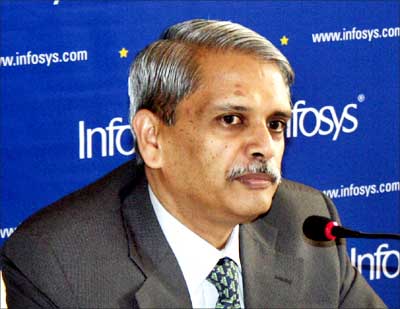
There is no doubt in our capabilities, says the Infosys co-founder.

Amazon Web Services (AWS) on Friday announced setting up of its second data centre region in India in Telangana that will be operational by mid-2022, and will see the tech giant investing about Rs 20,761 crore. While AWS did not comment on the investment detail, Telangana IT and Industries Minister KT Rama Rao tweeted that AWS will invest Rs 20,761 crore ($2.77 billion) to set up multiple data centres in the state.

Modi cautioning that cryptocurrency can spoil the youth.

Siva Prasad Nanduri, chief business officer, TeamLease Digital, outlines the skills that will help you get a job in 2023.

'Every time a new tech comes in, there are a set of people who will predict that this will be the end of Indian IT and every time the Indian IT industry and overall technology providers have proven to be resilient.'

Virtually addressing employees of Air India across the globe, he said for the airline to be the best again there will be an organisational redesign, and it will "require a huge transformation, probably the largest transformation and the change all of you would ever go through". The carrier will expand its "outreach both domestically and internationally" and it has the desire to connect India with every part of the globe, he added.

First acquisition under Sikka's plan of buying technologies for tomorrow

It is eyeing the transportation and infrastructure modernisation opportunity in the country, expected to attract $500 billion in investment over the next five years.

Rather than going through the tedious, hit-or-miss process of physically designing hull forms and superstructures for warships and then determining how visible they are to radar, the company will simulate this process on supercomputers.

'Many who have experimented with online education will adopt a blended model once things return to normal,' edX CEO and founder Anant Agrawal tells Anjuli Bhargava.

An increasing number of hiring managers are opting for video conferencing platforms to know the candidates, explains Narayan Bhargava, chairman and managing director, Calibehr.

'We are working in association with the state government and other transmission companies to make sure that the city never experiences blackouts'

AI, cloud computing, data analytics are a few areas companies are looking for proficiency in

Last year, it was not just the economy that slowed hiring. Employers were also unable to complete the verification process because of the lockdowns, resulting in delays in hiring and an increase in discrepancies between an employee's professed abilities and the reality. The experience is driving many companies to automation. In a recent EY survey, 56 per cent of the companies said they'd automated their processes, while 72 per cent felt technology could be leveraged to digitise employee records.

Ashish Narsale/Rediff.com brings you amazing gadgets and mobile devices from CES 2022.

'AI will be bigger than the advent of the Internet or the harnessing of electricity.' 'India must embrace it with all its might,' says NITI Aayog CEO Amitabh Kant.
